Home / Blog / Sunscreens / Melanoma: causes, symptoms and how to prevent it
Melanoma: causes, symptoms and how to prevent it

Published: 5/23/2025
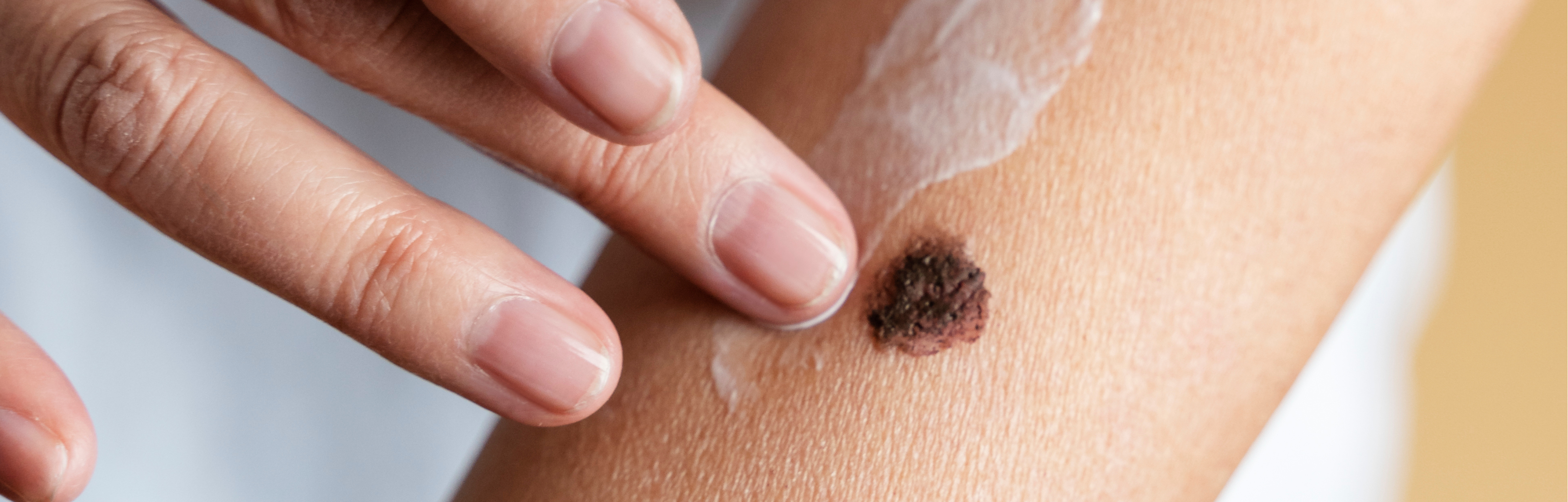
23 May, World Melanoma Day. Melanoma is one of the most aggressive types of skin cancer and, sadly, it is claiming more and more lives. That is why prevention and early detection are so important. Below, we explain everything you need to know about melanoma.
What is melanoma?
Melanoma is a type of skin cancer that develops from melanocytes, the cells in our skin that produce the pigment, or melanin, which gives us that tanned tone so many people like in summer. It can appear both in sun-exposed areas and in areas that are not exposed, although it is more common on the face, back or legs.
Causes of melanoma
There are different risk factors that can lead to melanoma on the skin:
- Genetic predisposition, family history of melanoma.
- Fair skin, blonde or red hair, and/or light-coloured eyes. These skin types are more sensitive and tend to be fairer and more vulnerable.
- New, atypical or changing moles.
- Weakened immune system.
- Repeated sunburn.
- Frequent sun exposure, especially during the hours of greatest intensity.
- Use of tanning beds.
- Not using sunscreen or using it incorrectly.
Mole or melanoma?
We must pay close attention to our moles, both existing ones and new ones. These can become cancerous. As a result, people with many moles, large moles or moles in very exposed areas may be more likely to develop this skin cancer if they do not take proper care and monitor them correctly.
Symptoms of melanoma
The most characteristic symptoms and signs of melanoma are summed up in the ABCDE rule:
- Asymmetry: The shape of the mole is irregular.
- Borders: They are irregular, uneven, jagged or poorly defined.
- Colour: It is not uniform and may include different shades of brown, black, blue, red, white or even pink.
- Diameter: The mole measures more than 6 mm. Although this is not a sign on its own, as melanomas can be smaller.
- Evolution: There are changes in size, shape or colour over time.
Other symptoms or warning signs include the appearance of a new, black or unusual mole that looks different from the rest (the ugly duckling sign). These could be cancerous moles.
Early detection of melanoma
In these cases, the key lies in early diagnosis. To achieve this, it is important to:
- Annual check-up of moles.
- Monitoring moles using the ABCDE rule: We should go to the dermatologist whenever we see that one of our moles shows Asymmetry, Border changes, Colour (not uniform or has changed), Diameter (has changed or is too large), Evolution (changes and development).
- Consult a dermatologist if new moles appear.
It is very important not to skip any step in order to detect skin cancer caused by melanoma in time.
Does benign melanoma exist?
There is no such thing as "benign melanoma". The termmelanomarefers exclusively to atype of malignant skin cancer that originates in melanocytes, the cells responsible forproducing the pigment of the skin.Melanomas aredangerous because they can grow out of control, invade surrounding tissue and spread to otherparts of the body (metastasis). For this reason, it is crucial to carry out preventive measures. Melanoma is always malignant.
Measures to prevent melanoma
- Sun protection is the key measure in preventing melanoma.
- Limit how often you are exposed to the sun and avoid the strongest hours of sunlight during the day.
- Also protect yourself with hats, T-shirts, parasols...
- Specific mole protection according to skin type.
- Health education from childhood to encourage personal responsibility in caring for ourselves.
- Regular visits to the dermatologist.
- Avoid using tanning beds as much as possible.
Sunscreen: the key weapon against melanoma
Sunscreens act as a physical barrier on our skin, reflecting, dispersing or absorbing solar radiation. Some qualities that we must NOT overlook when choosing a good sunscreen are:
- Sun protection factor higher than 50.
- Protection against different types of radiation.
- Water and sweat resistance, so it stays on the skin for longer and especially if you do outdoor sports.
- A suitable texture to suit all preferences.
- It may contain active ingredients that make it more moisturising, help reduce pigmentation, treat wrinkles, correct acne, etc.
- Children should only use children's sun protection, but adults can also use children's products. Children's skin is more sensitive, so their sunscreen should have a special formula and filter.
- In the case of babies, we should check from what age the sunscreen can be used and make sure it is always a mineral filter to avoid reactions and provide full-screen protection. Babies should be exposed to the sun as little as possible and always with extra protection such as hats, T-shirts or a parasol, avoiding the hours of intense solar radiation.
How to use sunscreen correctly
We must follow 3 basic rules to ensure the correct use of sunscreen:
- Apply it 20 minutes before going out in the sun, so the product settles on the skin and starts to work. We must not forget areas such as the ears, feet or hands.
- You need to apply the right amount of product: For the face, 2-3 lines of sunscreen (the equivalent of our fingers) depending on the texture or fluidity of the facial sunscreen. For the body, we should apply enough to ensure a layer that covers the skin.
- We should always reapply sunscreen every 2 hours (or after swimming or heavy sweating) because solar radiation itself, friction, movement... gradually removes the product from the skin, so it needs to be reapplied.
When should we use sunscreen?
Sunscreen is much more than a cosmetic; it is an essential product for our health, something indispensable in our lives that we should use every day, not only in summer and whatever the weather: even if it is cloudy, raining or hailing. Wherever we go and whatever activity we do. Even in the car or on a plane or in our own home or office, if we are near a window.
Protect your skin from melanoma with our pharmacy sunscreens
At Farmaciasdirect, we offer the best pharmacy sunscreens, which meet all the key features above and suit every preference:
Avène Ultrafluido
Avène Ultrafluido is a facial sunscreen with a very lightweight texture that absorbs quickly and spreads beautifully. It also comes in a tinted version, Avène Fluido Con Color, to give you a healthy-looking glow and let you use it daily like a BB cream, but with the protection of a good sunscreen.
Anthelios for the family
The Anthelios sun milk is a body sunscreen that can be used by every member of the family. Its texture is very pleasant and lightweight. What is more, its packaging is eco-friendly.
Heliocare Stick
It is a sun protection stick for face and body. It is a very convenient and practical format, easy to carry and use, and loved by both children and adults. Heliocare Sport is a version for sportspeople because of these qualities and because it is water- and sweat-resistant. It also offers the paediatric option Heliocare Pediatrics to create full-screen protection; adults can use it too, as it even repairs the skin barrier.
It is a format we recommend for that full-screen protection to shield moles, dark spots, scars and even the eye contour area.
Post-Anthelios
After-sun care is essential in our bathroom and daily routine after sun exposure. Its formula helps repair, soothe, refresh and protect the area. It treats mild sunburn, although if there are other types of burns or blisters appear, you should see a doctor quickly.
Heliocare Mineral Pediatrics
Ideal for our babies, as its mineral filter creates full-screen protection and will not cause irritation to your baby's skin. It can be used from 3 months of age. We love it because it spreads very easily and is suitable for all skin types.
As you can see, following a good sun care routine and carrying out the preventive measures we have mentioned will be key both to preventing and to spotting the possible appearance of cancerous moles in time.