
Eczema or psoriasis: differences and treatment

Last updated: 3/31/2025
/ Published: 3/31/2025
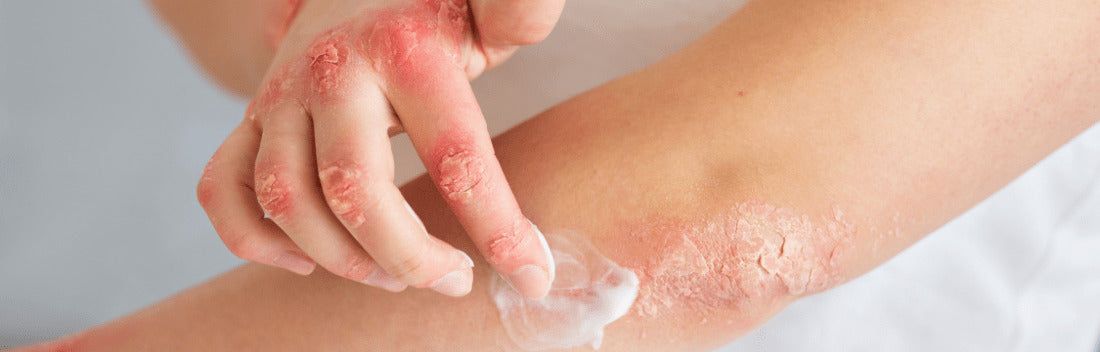
Eczema or psoriasis? We often do not tell them apart, but it is important to do so in order to treat them properly and prevent them from developing or becoming more severe. In this post, we tell you everything you need to know to learn how to distinguish between them and how to treat them.
The skin and its balance
The skin is the largest organ in our body, as it covers it completely. Our skin not only represents our physical appearance, but also our health, comfort and wellbeing. Well-cared-for skin will be healthy skin that can continue to perform its functions properly, which are essential for our lives:
- Provides protection against the outside world and infectious agents such as viruses, bacteria and other substances.
- Regulates temperature through sweat.
- Provides sensations, as it allows us to connect with the outside world through its touch and pressure receptors.
- Absorbs and releases: it can absorb some substances and eliminate others through sweat.
- Produces vitamin D, which is essential for our body.
Barrier function: hydrolipidic film and its balance
On the skin there is a layer called the hydrolipidic film. This film is made up of lipid and aqueous substances which, when balanced, allow the skin to continue performing its functions. In this way, the hydrolipidic film makes up the barrier function of our skin.
If the proportion of the aqueous or lipid component changes, an imbalance occurs: the skin becomes altered and will not work properly. This results in signs and symptoms that can affect the patient's wellbeing and quality of life, such as flaking, itching, burning, tightness, redness or eczema.
Eczema or psoriasis?
Establishing the difference between eczema and psoriasis is often difficult, as the symptoms and signs are similar. The difference is determined visually by observing the appearance of the plaques and lesions, which are different from one another.
What is psoriasis?
Psoriasis is a skin condition caused by a genetic predisposition. It usually starts to appear during adolescence or in adults over the age of 30. Some factors that trigger a psoriasis flare-up are stress, tiredness, fatigue, emotional distress, skin irritation or unhealthy lifestyle habits.
In psoriasis, there is an uncontrolled and accelerated renewal of the outermost layer of the skin, whose cells build up in the form of plaques.
Psoriasis has no cure, but it can be managed by addressing the triggering factors and following a good daily hygiene and moisturising routine with specific products that reinforce the barrier function and soothe it (emollient products). In addition, medical supervision is required and the appropriate medication should be taken, which is usually based on the use of corticosteroids to treat flare-ups.
What is eczema?
The eczema is a manifestation of an imbalance in the hydrolipidic film of our skin. It is a flaking process in the form of plaques accompanied by itching. It can also appear through contact with irritants, changes in environmental humidity, atopic dermatitis or others.
Differences between eczema and psoriasis
Eczema appears in the form of reddish, flaky plaques, accompanied by itching. It usually appears behind the knees and in the folds on the inner side of the elbows.
Featured products


Psoriasis plaques are usually whitish or silvery in colour and are accompanied by itching and/or pain. They may also appear with inflammation, irritation and flaking and may even develop blisters. They usually appear on the elbows, knees or scalp.
Differences between atopic dermatitis and psoriasis
We should not confuse eczema or psoriasis with atopic dermatitis; it is a skin condition that usually appears in the first months of life and can continue into adulthood or last a lifetime; its origin is related to the immune system and an alteration of the skin's hydrolipidic film occurs. It appears with intense and persistent itching, redness and thickening of the skin. There are no plaques.
It is important to know that psoriasis and eczema can coexist, just as eczema and atopic dermatitis can.
If you are not sure which condition it is; or if the symptoms worsen, cannot be controlled or become persistent, we recommend seeing a dermatologist so they can assess, diagnose and manage the flare-ups.
How can psoriasis be managed? And eczema?
Both psoriasis and eczema can be treated, their appearance can be prevented or their severity reduced, by strengthening the skin barrier through our daily hygiene and moisturising routine.
To do this, we will use products with moisturising, nourishing, protective, repairing, regenerating and soothing active ingredients. In this way, our hydrolipidic film will remain balanced and we will avoid instability and fragility.
Creams for dermatitis and eczema
Below, we show you which are the best creams for eczema, dermatitis and psoriasis that you will find available in pharmacies:
Eucerin AtopiControl Hidroloción Calmante
Eucerin AtopiControl Hidroloción Calmante is a moisturising product intended for the basic daily care of dry, irritated, sensitive skin, with eczema or atopy. It helps relieve itching and provides hydration that lasts for 48 hours. This cream for dermatitis and eczema achieves this thanks to its formula rich in ceramides (repairing), hyaluronic acid (moisturising) and Licoalcon A (anti-inflammatory and antioxidant).
Its texture is ultra-light, it absorbs instantly and provides a great deal of comfort.
Ducray Dexeryl crema protectora
Ducray Dexeryl crema protectora is an emollient product used in the daily moisturising, repairing and soothing care of very dry, reactive, atopic, eczema-prone or oncology skin. It contains petroleum jelly and paraffin (protective active ingredients) and glycerol (moisturising).
It can be used from birth, making it suitable for the whole family.
Psoriasis creams in pharmacies
In our online pharmacy you will find a wide variety of creams and topical treatments for psoriasis, designed to relieve symptoms such as flaking, redness or itching. The most popular options include corticosteroid creams, urea creams and other emollients or moisturisers. This is the one we recommend:
Eucerin Urea 10% Loción
Eucerin Urea 10% Loción is a daily and intensive moisturising product that provides comfort for 72 hours. It relieves itching and softens the skin, making it ideal for caring for psoriasis-prone skin and textured skin, as it acts on plaques or excess skin. It achieves this thanks to its 10% urea concentration combined withnatural moisturising factors (NMFs) and ceramides (barrier function active ingredients).
Remember that, if you have any questions, you can always contact our team of expert pharmacists.


